Grow My Therapy
Grow My TherapyHow we build therapist websites
112 steps between a website and one that brings you clients.
Anyone can get a website in an afternoon now. Ask an AI and one appears. What it won’t tell you is what a therapy practice’s site has to get right to be found on Google, trusted by someone anxious at 11pm, and turned into a booked consultation. We worked that out across 60+ practices, and wrote it down as 112 steps.
- Steps in the method
- 112Steps in the method
- Run on every single site
- 80Run on every single site
- Individual checks inside them
- 570Individual checks inside them
- Practices built this way
- 60+Practices built this way
What a visitor sees · what went into it
- 1Credentials checked against the therapist’s own answers
- 2A page for every area served, each written for that place
- 3Who it’s for and where, in the words people search
- 4One clear way to book, on every page
- 5On screen in under 2.5 seconds on a phone
+ 107 more steps no visitor will ever notice, and a second person reviewing every page before launch.
A fair question
“Why not just ask ChatGPT to build it?”
You could. In a few minutes you would have a homepage that looks finished. We use AI every day ourselves; it is a big part of why we are fast.
But a site that looks finished and a site that works are separated by a long list of things nobody sees: what Google reads, what an anxious reader needs before they will call, what breaks on a phone, what is quietly wrong in the fine print. A prompt does what you ask. The hard part is knowing what to ask, and then checking every answer.
- From a promptA homepage that looks finishedEvery page read in full, on a phone and a laptop, by two people, before you ever see it
- From a promptCopy that could belong to any therapistYour voice, your specialisms and your town, with every credential checked against what you told us
- From a promptInvisible to Google until someone sets it upPage titles, sitemap, structured data and Search Console in place by launch day, so Google can read you from week one
- From a promptThe rankings your old site earned, goneEvery old address pointed at its new page, so what you already rank for comes with you
- From a promptA contact form you hope worksA real enquiry sent through the live site before launch, and its arrival confirmed
- From a promptFinished the moment it is generatedLooked after for as long as you are with us, with unlimited changes made for you
What the 112 steps are for
112 steps, five jobs
We won’t walk you through all 112. You don’t need them; you need what they add up to. Every step exists to do one of five things for your practice, and none of them is “look nice”. Looking good is the starting point, not the job.
- 0127 steps · 10 on every site
Found by the people already searching
Most new clients start with a search: a specialism and a town, typed into Google or asked of an AI assistant. Your site has to be the clearest answer on the page.
- A page for each thing you want to be known for, and for each place you see clients, written for that place rather than copied
- Answers to the questions people ask before booking, written so Google and AI assistants can quote them
- Your Google Business Profile matched to your site, so the map listing and the website tell the same story
- 0223 steps · 16 on every site
Trusted in the first ten seconds
The person reading your site is often deciding whether to reach out about the hardest thing in their life. The page has to feel like the right room before they have read a word.
- Copy drawn from your own words, your directory profile and your current site, then read for anything that sounds machine-written
- “I” for a solo practice and “we” for a group, held on every page, so one clinician never reads like a clinic
- Your photographs, your colours and your credentials, with nothing left over from anyone else’s site
- 0311 steps · 9 on every site
Easy to say yes to, and you can see it working
Someone who is ready should not have to work to reach you. And you should be able to see where your enquiries are coming from.
- A consultation form that asks three questions first and shows the rest once someone has started, so more people finish it
- Fast on a phone: your home page and key pages score 90+ on Google’s own mobile speed test before launch
- Calls and form enquiries tracked from day one, in analytics accounts that belong to you
- 0424 steps · 23 on every site
Checked like it carries your name
Because it does. Before you see your site, the developer who built it goes through every page, and then a second person whose only job is finding what is wrong goes through it again.
- Every page opened and read in full, at phone and desktop sizes
- Every request you made on your call ticked off, one by one, on the live site
- A privacy policy and terms written for your practice, naming you and your town, not a template
- 0527 steps · 22 on every site
Moved over without losing anything
Switching sites is where practices lose things: email, rankings, the enquiry that arrived mid-switch. So launch day has its own checklist.
- Your domain moved with a record of its old settings kept, in case anything needs putting back
- Confirmation emails sent from your own domain, so they land in the inbox rather than spam
- Your sitemap submitted to Google on launch day, with indexing requested for your key pages
From the other side of the method
Don’t take our word for it
Steps are our side of it. This is what they feel like to the practices on the receiving end.
Inside the steps
The small things that quietly cost you enquiries
Most of the 112 steps exist because, somewhere, something went wrong once. None of these would stop a site from looking finished. Each of them can stop a client from getting in touch.
- Another practice’s name in your fine print
Sites built from templates often carry the last owner’s town, phone number or privacy policy. We trace every name, number and photo on your site back to you.
- An email address that only brings spam
Your address stays off the page and enquiries come through the form. Your phone number stays one tap away.
- A form that asks too much, too soon
Three questions first. The rest appear once someone has started typing, which is when they are most likely to finish.
- White boxes where your photos should be
Images are on screen the moment the page appears, and nothing jumps around under the reader’s thumb.
- A solo practice that sounds like a clinic
“I” or “we”, chosen for how you actually practise, and kept consistent across every page.
- A shared link that looks like an accident
When someone sends your site to a friend, it shows a proper preview card made for it, not a cropped corner of your homepage.
- A contact form nobody tested
Before your launch call, a real enquiry goes through the live site and we confirm it arrived.
- Credentials typed from memory
License titles, cities, insurance and fees are checked against your own answers, every time, by someone who did not write them.
That is eight. There are 570 checks like them inside the 112 steps, and every one that applies to your site is ticked by a person before it moves on.
Same method. No two sites alike.
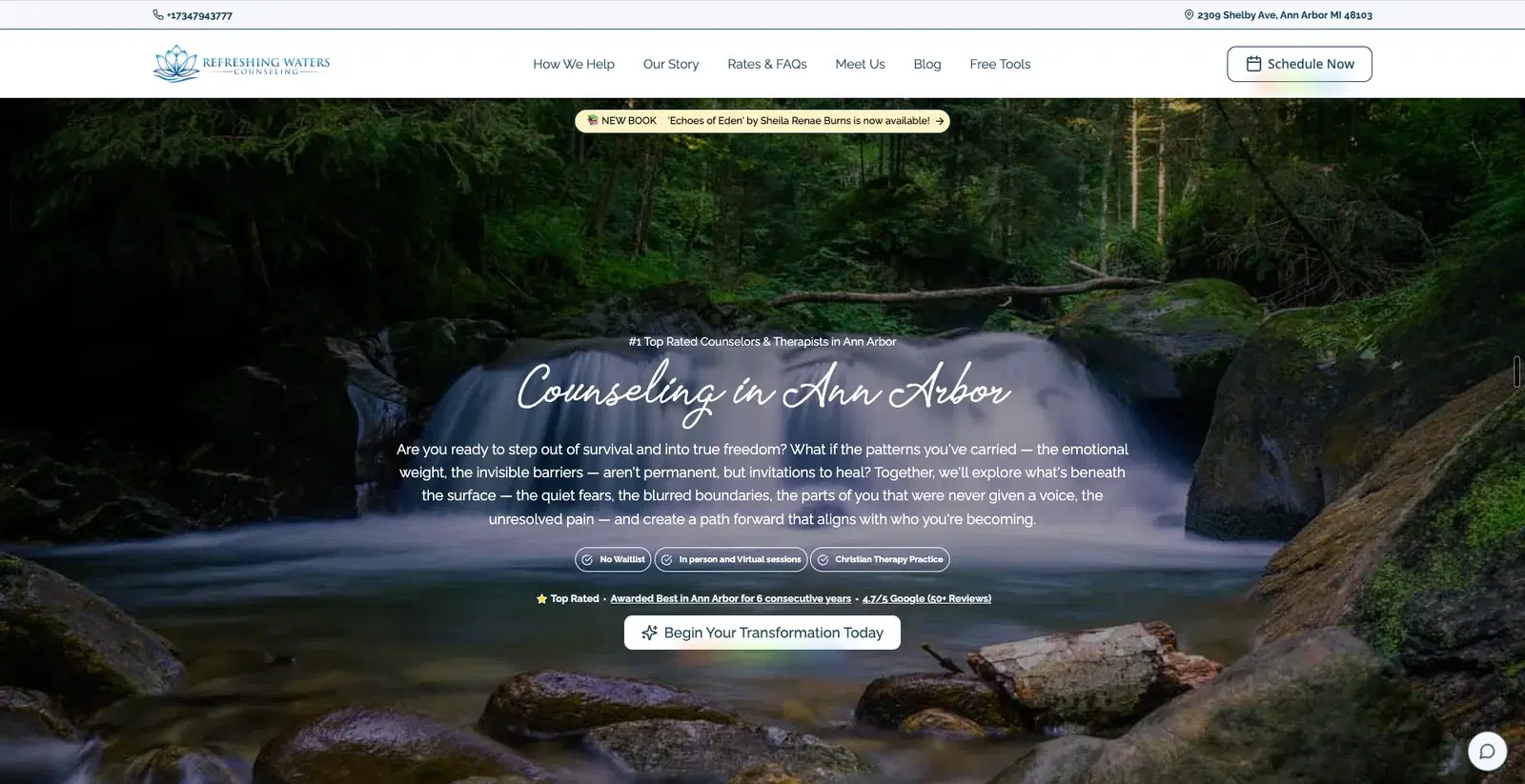
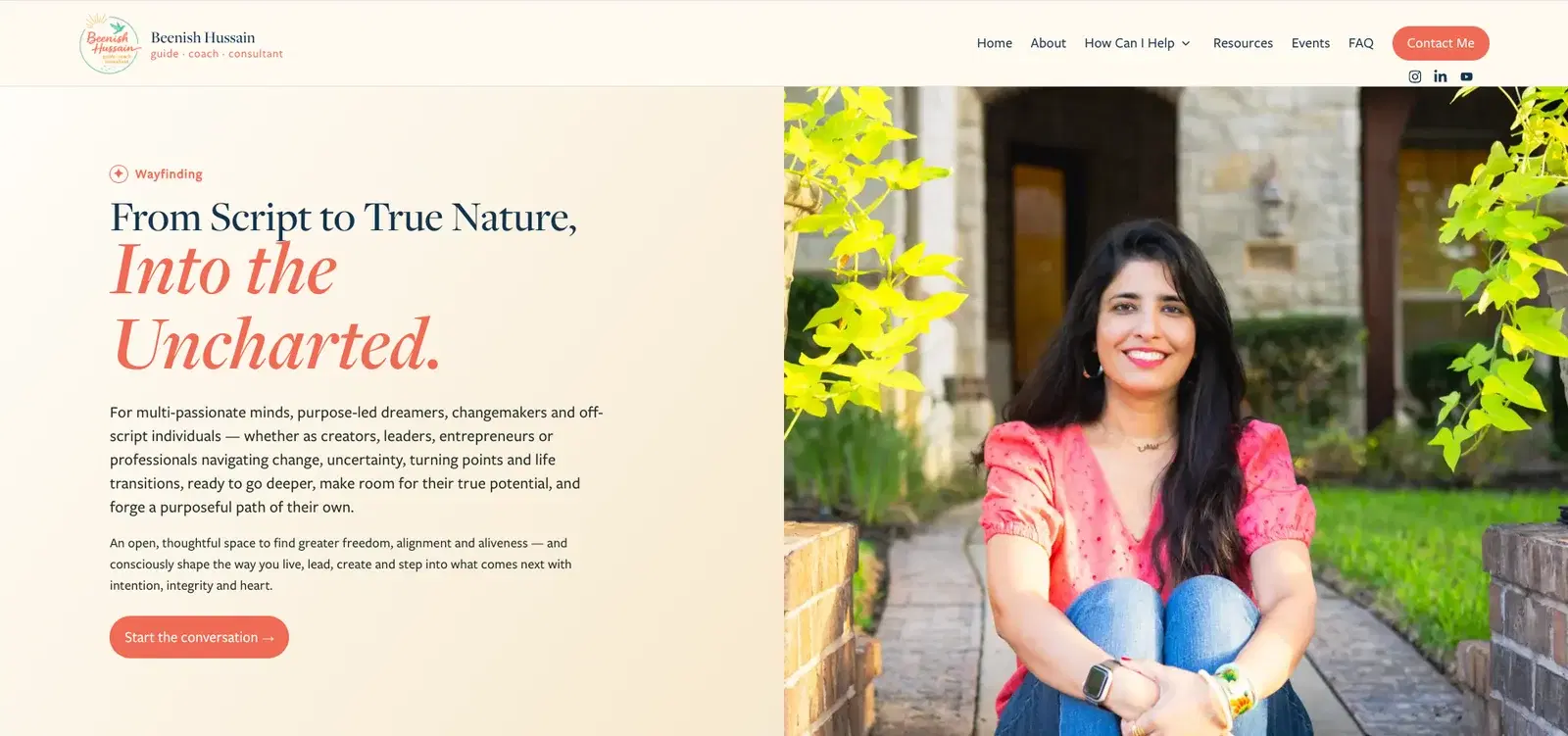
The steps are the same for every practice. What comes out is not: each site is shaped around the person and the work behind it.
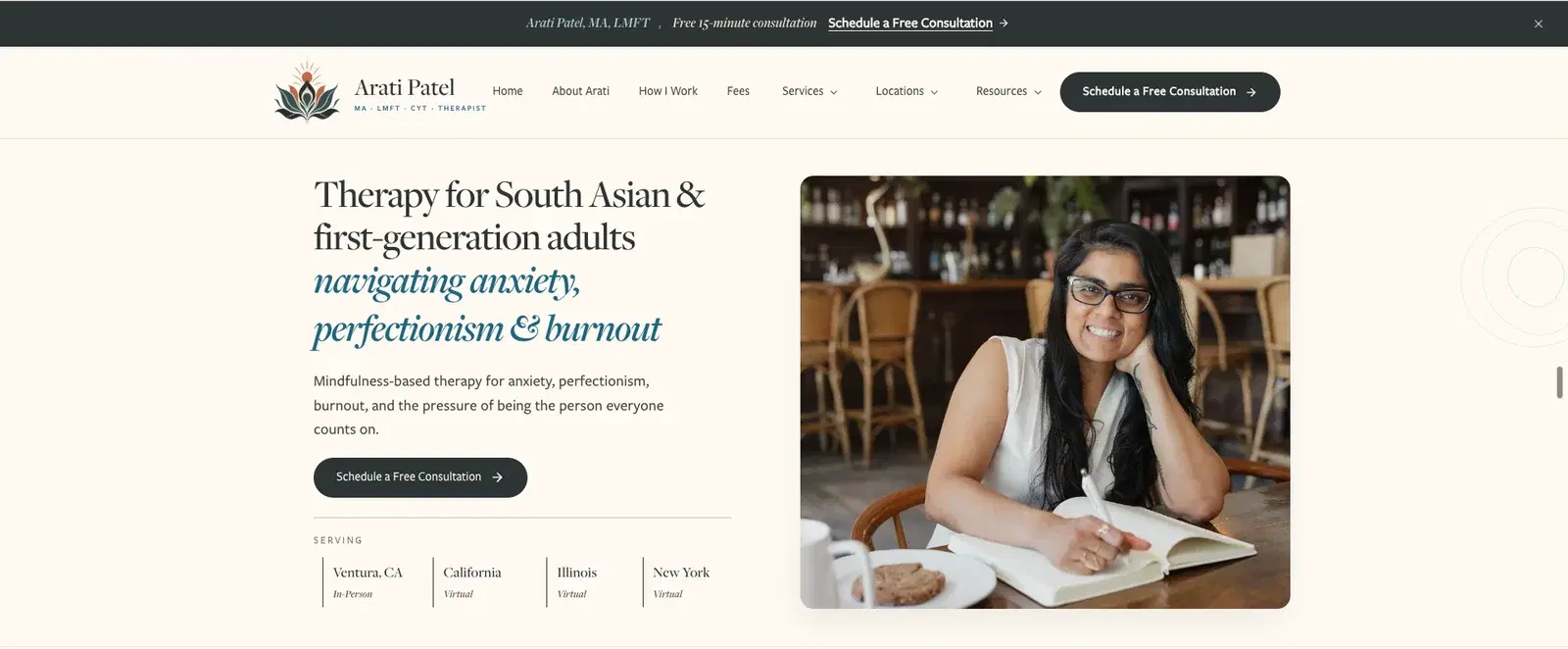
- Arati Patel — opens website in a new tab
Warm, personal and grounded
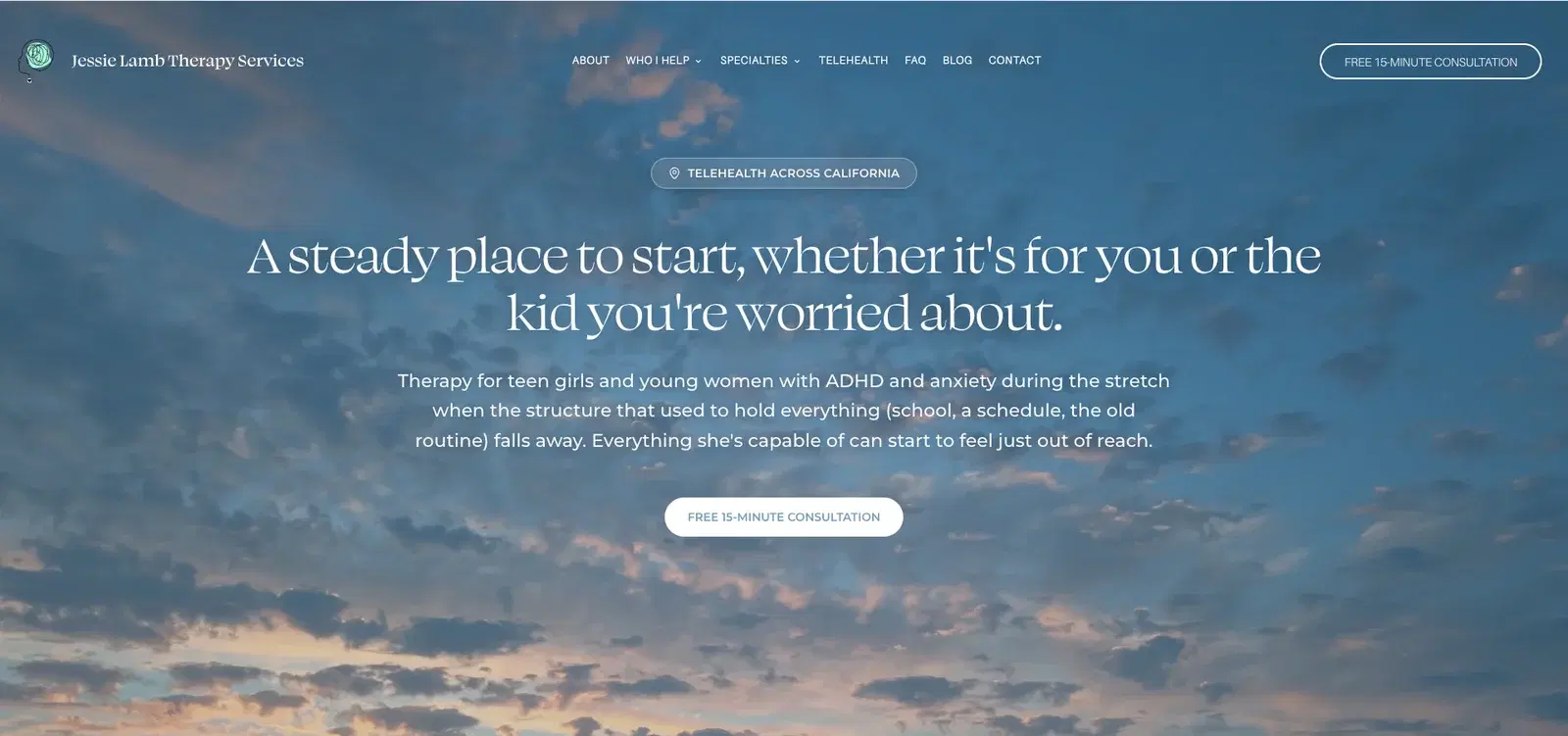
- Jessie Lamb Therapy — opens website in a new tab
A little space to breathe
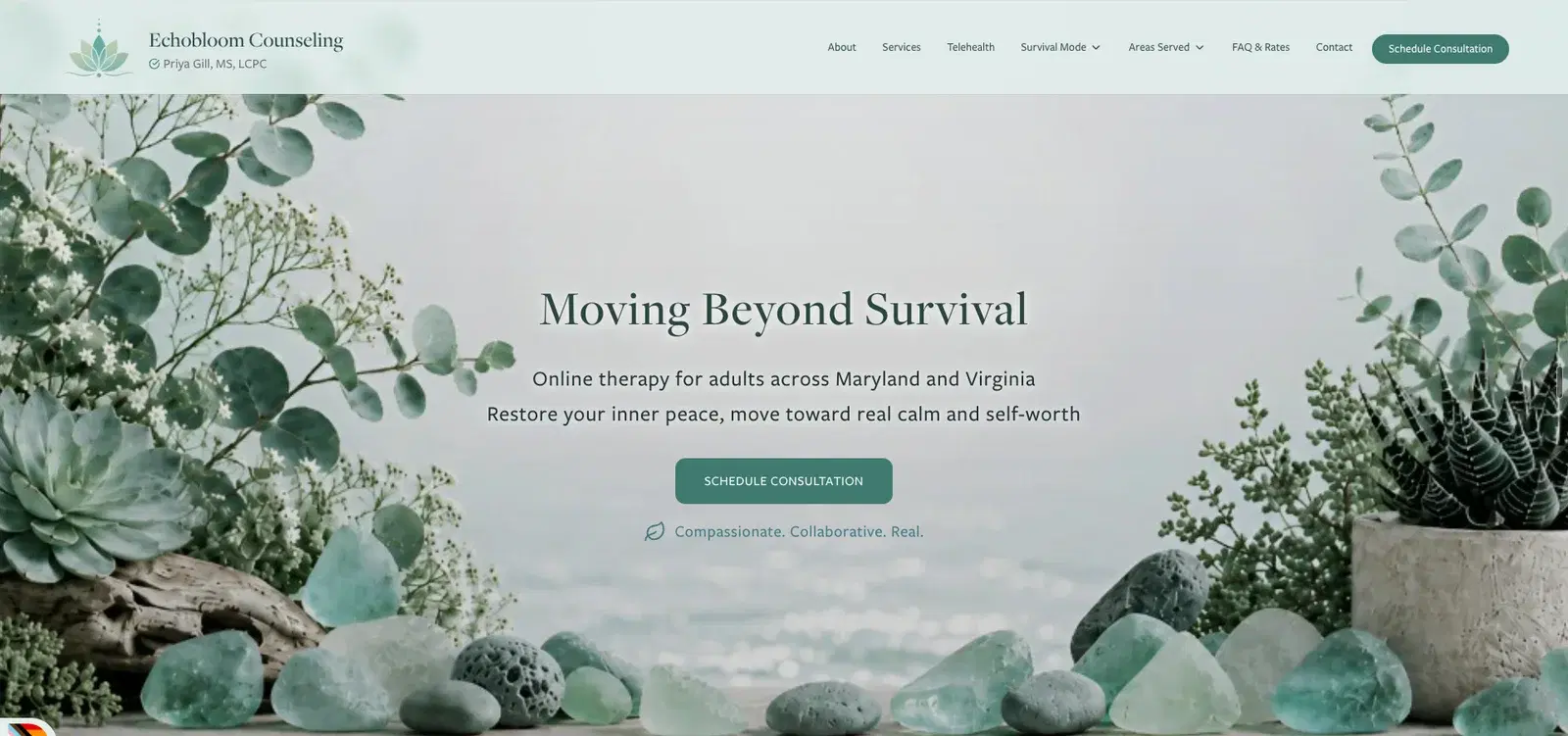
- Echobloom Counseling — opens website in a new tab
Soft greens and a sense of calm
- Beenish Hussain — opens website in a new tab
Expressive, bright and full of possibility
Your part
Of the 112, you are needed for a handful
You are a therapist, not a project manager. Almost all of this happens without you, and when we do need you, we ask in plain language.
- 01
Tell us about your practice
A short form and one call. Bring your current site, your directory profile, or nothing at all. Where something is missing, we draft it and you correct it.
- 02
Your requests become steps too
Everything you ask for on the call, from the look you want to the page you have always meant to add, is written into your site’s own checklist alongside the 112, and ticked off on the live site before launch.
- 03
Review a site that is already checked
You see the whole site once it has been through both reviews, and tell us what to change in your own words.
- 04
Go live, then let it keep working
We launch at a time that suits you and re-check everything on your real domain. After that come unlimited changes made for you, and a monthly report on how the site is doing.
Want the practical side: what is included, what you own, and how changes work after launch? It is all on the website design for therapists page.
Real Results, Real People
Watch Our Client Stories
Therapists across the United States and Canada share how Grow My Therapy transformed their online presence.

Megan
Watch Testimonial →
Anita
Watch Testimonial →
Dennis
Watch Testimonial →
Evolve Therapy
Watch Testimonial →

Sheila
Watch Testimonial →
Erin
Watch Testimonial →
Laura
Watch Testimonial →
Ilah Brock
Watch Testimonial →
Andrew
Watch Testimonial →
Bill
Watch Testimonial →

Regina
Watch Testimonial →
Ruth
Watch Testimonial →
Karon
Watch Testimonial →

Rebecca
Watch Testimonial →
Dr. Moffett
Watch Testimonial →
Drew
Watch Testimonial →
Megan
Watch Testimonial →
Anita
Watch Testimonial →
Dennis
Watch Testimonial →
Evolve Therapy
Watch Testimonial →
Sheila
Watch Testimonial →
Erin
Watch Testimonial →
Laura
Watch Testimonial →
Ilah Brock
Watch Testimonial →
Andrew
Watch Testimonial →
Bill
Watch Testimonial →
Regina
Watch Testimonial →
Ruth
Watch Testimonial →
Karon
Watch Testimonial →
Rebecca
Watch Testimonial →
Dr. Moffett
Watch Testimonial →
Drew
Watch Testimonial →
Questions
What therapists ask us
- Do you use AI to build sites?
- Yes, every day. It makes us faster at the parts a machine does well. It does not decide what goes on your site, and nothing it produces reaches you unchecked: every page is read by people who know what a therapy practice’s site has to get right.
- Why 112 steps?
- Because that is how many there are today. There were fewer when we started. Each one was added when we found something worth getting right on every site, and the number keeps moving as we learn. 80 run on every site; the rest switch on when your practice needs them, such as several offices, a blog to move over, or a Google Business Profile to tune.
- I already have a website. Do I start over?
- No. Your words, photos and blog posts come with you, and every old link is pointed at its new page, so you keep what Google already knows about you.
- Do I need to know anything technical?
- No. Your part is a form, a call and a review. You never open a design tool, a hosting dashboard or a plugin update.
- Can you guarantee I will rank first on Google?
- No, and be wary of anyone who does. What we can promise is that nothing on the site stands between your practice and the people searching for it. Ranking keeps moving after launch; if you want someone working on it every month, that is our marketing and SEO service.